- What is an EPC?
- EPC Ratings Explained: A to G (and A+)
- What is EPC A+?
- Why EPCs Matter for Social Housing Asset Managers
- When do you need an EPC?
- How is an EPC Assessment Carried Out?
- How to Improve EPC Ratings in Social Housing
- Keeping EPCs Up to Date
- The 2030 MEES Deadline: What Social Landlords Need to Know Now
- Funding Available to Improve EPC Ratings
- EPCs for Net Zero and ESG Reporting
- Conclusion & next steps
- FAQs
What is an EPC?
EPC stands for Energy Performance Certificate. It is an official document that rates how energy efficient a building is, on a scale from G (least efficient) to A+ (most efficient).
Most people will be familiar with EPC ratings. If you have bought, sold or rented a home, you require a certificate. For anyone working in social housing, understanding EPCs is not optional. They are the government’s primary tool for measuring, regulating, and improving the energy performance of the nation’s housing stock.
An EPC contains three key pieces of information:
- The property’s current energy efficiency rating (its EPC band)
- An estimated energy cost for the property
- A list of recommended improvement measures, with their projected impact on the rating
There are two types of EPC in the UK: one for domestic (residential) properties, and one for non-domestic (commercial) buildings. For social housing asset managers, the domestic EPC is the one you will be working with most often.
EPC Ratings Explained: A to G (and A+)
EPC ratings run from G at the bottom to A at the top, with A+ as the highest achievable rating. Each band reflects how much energy a property uses per square metre, and how much of that energy is lost.
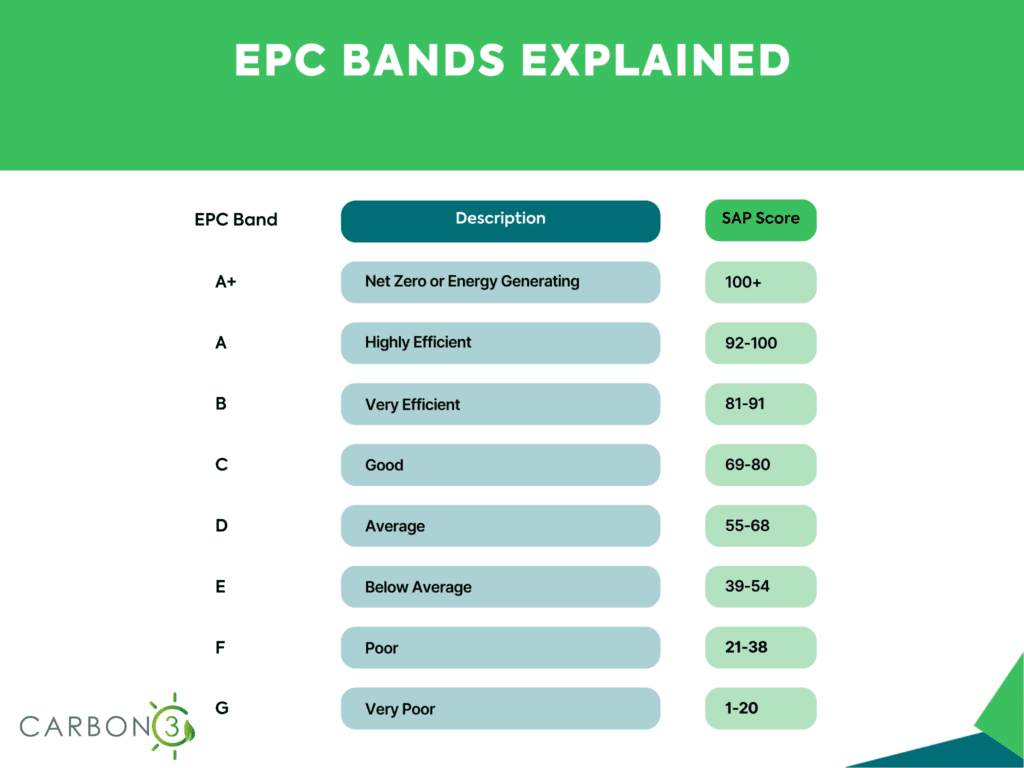
The rating is calculated using the Standard Assessment Procedure (SAP), which is a methodology that measures how much energy a property uses and loses per square metre. A score of 100 means no net energy cost; anything above 100 means the property is generating more energy than it consumes. A feat which is only possible with renewable energy, such as solar photovoltaic (PV) or wind turbines.
What is EPC A+?
EPC A+ is the highest band on the scale and indicates a property with zero or negative carbon emissions. Homes rated A+ typically feature a combination of solar photovoltaic (PV) panels, heat pump heating, heavily insulated walls and lofts, and smart energy management systems. In social housing, achieving A+ is aspirational, but EPC B and above is increasingly achievable with the right package of measures, even in difficult or non-standard stock.
Why EPCs Matter for Social Housing Asset Managers
EPCs sit at the intersection of three pressures that every social housing asset manager is navigating right now, which are regulatory compliance, fuel poverty, and net zero commitments.
Regulatory Compliance
For the first time, the government is introducing a statutory minimum energy efficiency standard for the social rented sector. All socially rented homes in England must achieve EPC C by 1 April 2030. This is not a consultation position; it was confirmed in the government’s January 2026 progress update on social and affordable housing. Compliance will be regulated by the Regulator of Social Housing (RSH) as part of the Decent Homes Standard.
Fuel Poverty
Before new regulations come into effect in 2030, social homes are not required to meet any minimum EPC standard; current requirements are roughly equivalent to an EPC F rating. This has real consequences for tenants. Properties in bands D to G are significantly more expensive to heat, and millions of social housing residents live in fuel poverty as a direct result of poor energy efficiency. Improving EPC ratings is one of the most direct interventions available to social landlords.
ESG and Net Zero Reporting
Your portfolio’s EPC distribution is increasingly central to ESG reporting. Investors, regulators, and the Regulator of Social Housing are all scrutinising the energy profile of housing stock more closely than ever. A proactive EPC improvement programme provides measurable, auditable evidence of progress towards your organisation’s net zero goals.
When do you need an EPC?
A valid EPC is required whenever a property is built, sold, or rented. For social landlords, this means every property in your rental portfolio must have a valid EPC in place whenever a tenancy is active or commenced.
An EPC is valid for 10 years from the date of issue. If a newer EPC is produced during that period, for example, following improvement works, the most recent certificate takes precedence. It is best practice to update EPCs after any significant retrofit works rather than waiting for the 10-year expiry.
Public buildings over 500 square metres that are regularly visited by the public require a Display Energy Certificate (DEC) rather than a standard EPC. This applies to communal facilities, offices, and other non-domestic spaces within your estate.
Exceptions to the EPC Requirement
Not all properties require an EPC. Exemptions include:
- Listed or protected buildings where minimum energy performance measures would alter their character
- Temporary buildings in use for two years or less
- Places of worship
- Small detached buildings under 50 square metres
- Buildings due to be demolished
- Industrial sites or non-residential agricultural buildings with low energy use
Communal Areas and Blocks of Flats
For social housing providers managing blocks of flats, individual dwellings each require their own EPC when rented or sold. Communal areas may require a separate non-domestic EPC. When planning a block retrofit, reviewing all EPCs together is the most efficient way to prioritise and batch works.
How is an EPC Assessment Carried Out?
An EPC must be issued by an accredited Domestic Energy Assessor (DEA) or Non-Domestic Energy Assessor. You can find a registered assessor via the official government EPC register at gov.uk.
The assessor will visit the property and examine:
- Insulation
- Construction type and fabric
- Heating systems
- Lighting systems
- Ventilation systems
- Windows and doors
- Renewable energy systems
The assessor takes measurements and photographs, and the findings are inputted into the SAP calculation to produce a score and a band. The certificate will also include a list of recommended measures, each showing its estimated impact on the EPC rating and potential energy cost savings.
Can an EPC Be Wrong?
Yes. EPCs can be inaccurate if measurements are taken incorrectly or if contributing factors are missed, for example, if recent insulation works are not recorded. If you believe an EPC on your stock is incorrect, you can dispute it through the official government website. Inaccurate low ratings can misrepresent the true performance of your stock and undermine funding applications, so it is worth periodically cross-checking your EPC register against any improvement works you have completed.
How to Improve EPC Ratings in Social Housing
This is where planning becomes action. The measures below are the most commonly used to move social housing stock up the EPC scale.
1. Fabric First: Insulation
Insulation is consistently the biggest driver of poor EPC ratings. A fabric-first approach addresses the thermal fabric of the building before looking at heating systems.
- Cavity wall insulation is one of the most cost-effective improvements available for properties built after the 1920s
- Loft insulation should be a minimum of 270mm; under-insulated lofts are among the most common causes of low ratings
- External or internal wall insulation may be needed for solid-wall properties
2. Windows and Doors
Single-glazed windows are a significant source of heat loss. Upgrading to double glazing can meaningfully improve a property’s SAP score. Triple glazing offers further gains but at substantially higher cost, one often not worthwhile for housing providers.
3. LED Lighting
Replacing remaining incandescent or halogen bulbs with LED fittings is one of the lowest-cost EPC improvements available. LED lighting uses up to 90% less energy than traditional bulbs and can nudge a property up a band for a minimal cost.
4. Heating System Upgrades
Replacing an old gas boiler with a modern, efficient alternative improves EPC ratings, but the biggest gains come from replacing fossil fuel heating entirely.
Installing an air source heat pump (ASHP) has been shown to improve EPC ratings more than most fabric-first measures, particularly as the new EPC methodology places greater weight on the carbon intensity and efficiency of the heating system. Heat pumps are also central to the government’s net zero heating strategy and are eligible for the Boiler Upgrade Scheme, which offers grants of up to £7,500.
5. Solar PV Panels
Solar photovoltaic panels improve SAP scores more than most other single measures because they generate energy for the home rather than simply reducing how much is lost. A typical 4kW system can add between 9 and 15 SAP points to a property’s score, potentially moving it up one or two EPC bands.
Solar PV pairs particularly well with battery storage, which allows the energy generated to be used by residents rather than exported to the grid, maximising bill savings and further improving the property’s energy profile.
6. Battery Storage
Battery storage systems work best when combined with solar PV, as they store clean energy generated for use outside of daylight hours.
However, it also functions as an effective fuel-poverty measure all on its own. Residents can charge overnight during economy 7 tariffs if they are eligible, and then discharge the cheaper energy at times of higher grid rates.
7. Smart Controls and Heating System Upgrades
Under the reformed EPC methodology being introduced from 2026, smart readiness will become an explicit metric. Properties that can integrate smart thermostats, time-of-use tariffs, and demand-response technologies will score better under the new system. Installing smart heating controls alongside other measures is therefore increasingly worthwhile.
Take a look at our recent case studies to see how we’ve utilised low carbon measures to improve EPC ratings.
Resident Engagement
When looking at how EPC ratings can be improved, it is important to consider your social residents. They need to be on board with the retrofit programme as unhappy residents can cause major delays.
During installation, it is the residents who suffer interruptions to their homes and their lives for days at a time, so they need to not only be kept involved in the retrofit process to understand timeframes, but additionally they need to understand the benefits of living in a home with an upgraded EPC rating.
See how resident engagement works in practice in our whole-borough decarbonisation programme with a council in Kent.
Keeping EPCs Up to Date
After completing any improvement works, commission a new EPC to reflect the changes. This is important for three reasons: it keeps your asset register accurate, it provides the documentary evidence required for compliance and funding claims, and it ensures your portfolio data genuinely reflects the improvements you have made.
The 2030 MEES Deadline: What Social Landlords Need to Know Now
The regulatory landscape for social housing energy efficiency has moved significantly since 2024. Here is a clear summary of where things stand as of early 2026.
The 2030 Standard
All socially rented homes in England must achieve EPC C by 1 April 2030. This was confirmed in the government’s January 2026 progress update. Compliance will be regulated by the Regulator of Social Housing as part of Criterion D (thermal comfort) of the reformed Decent Homes Standard.
The government’s preferred approach requires providers to meet the fabric performance metric first, then either the heating system metric or the smart readiness metric by 2030. A second metric must be met by 1 April 2039.
The New EPC System: HEM
The government is overhauling the EPC methodology entirely, replacing the existing Energy Efficiency Rating (EER) system with the Home Energy Model (HEM). New EPCs using HEM metrics are expected from late 2026. From 1 October 2029, the new system will become the compulsory basis for all EPCs.
EPCs issued between 2026 and 2030 will display both the old and new methodologies side by side, so neither providers nor residents are disadvantaged during the transition.
Transitional Arrangements
Homes that already achieve EPC C under the current EER methodology, and hold a valid certificate demonstrating this, will be considered compliant with MEES for the duration of that certificate’s 10-year validity. This means that acting now to bring stock to EPC C pays dividends that last a decade.
The £10,000 Spend Exemption
A spend exemption of £10,000 per property applies. Where a property cannot reach EPC C within this cost, landlords may register an exemption. All expenditure on qualifying energy efficiency improvements from 1 October 2025 counts towards this cap, meaning providers who have already begun improvement programmes have a head start.
The Scale of the Challenge
Social housing currently have no minimum EPC requirement, with effective standards roughly equivalent to EPC F. The step to EPC C across an entire portfolio by 2030 is significant. Asset managers who have not yet conducted a full EPC audit of their stock should treat this as an urgent priority.
Funding Available to Improve EPC Ratings
The government has allocated substantial funding to support the transition to EPC C for social housing. Here is the current landscape.
Warm Homes: Social Housing Fund (WH:SHF)
The Warm Homes: Social Housing Fund has allocated £1.29 billion between 2025 and 2028 for energy efficiency upgrades and low-carbon heating measures in social housing across England. Registered providers of social housing, including housing associations and local authority landlords, can access this funding for measures including insulation, solar PV, and heat pump installation.
Warm Homes: Local Grant (WH:LG)
The Warm Homes: Local Grant was launched in April 2025 as a three-year initiative with £500 million allocated to local authorities across England. It focuses on improving fuel-poor homes in EPC bands D to G, and can fund a full package of upgrades. Eligible households must meet income thresholds or live in designated deprived postcodes.
Boiler Upgrade Scheme (BUS)
The Boiler Upgrade Scheme offers grants of up to £7,500 for the installation of air source heat pumps. The scheme runs until 2029/30 with a committed budget of £2.7 billion. For social housing providers coordinating heat pump installations at scale, this scheme can significantly reduce the capital cost per unit.
If your organisation does not qualify for above government funding, see our funding options page for other options.
EPCs for Net Zero and ESG Reporting
An up-to-date EPC register is one of the most practical tools available to social housing asset managers for planning and reporting on decarbonisation.
At a portfolio level, your EPC distribution tells you:
- Which properties are already compliant with the 2030 standard
- Which require the most urgent investment
- Where improvement works can be batched geographically to reduce cost and contractor mobilisation time
- How your portfolio’s carbon profile is tracking against your Green Plan
For ESG reporting, a credible EPC improvement trajectory provides measurable, auditable evidence of progress. It also allows you to identify properties where investment in solar PV, battery storage, or heat pumps would have the greatest impact on both the EPC rating and residents’ energy bills.
Conclusion & next steps
EPCs are no longer a background compliance exercise for social housing providers. The 2030 MEES deadline, the introduction of the Home Energy Model, and the availability of significant government funding through the Warm Homes Plan have all converged to make EPC improvement one of the highest-priority projects for asset managers across the sector.
The organisations that will manage this transition most effectively are those that start with a clear picture of their stock, such as an accurate, up-to-date EPC register, and build a costed, phased improvement programme around it. Resident engagement should also be a day one priority to avoid costly delays.
Carbon3 has carried out asset audits for multiple local councils and social housing providers. We advise on the most effective improvement measures for any budget, and can design and deliver a full decarbonisation programme, from initial EPC audit through to installation, commissioning, and ongoing monitoring.
Get in touch to find out how we can help your organisation get ahead of the 2030 deadline.
FAQs
Carbon3 is a decarbonisation specialist working across the social housing, public sector, and commercial sectors. Find out more about our work in social housing.