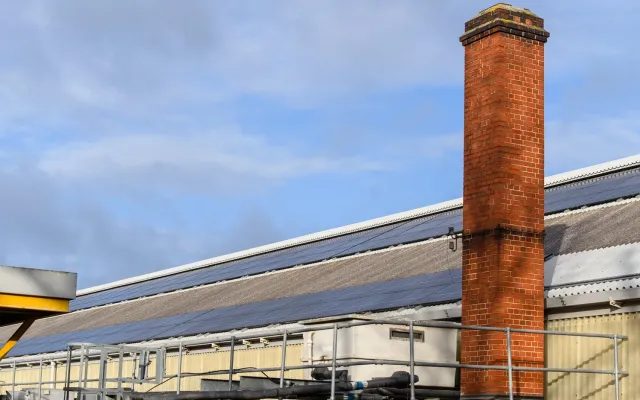
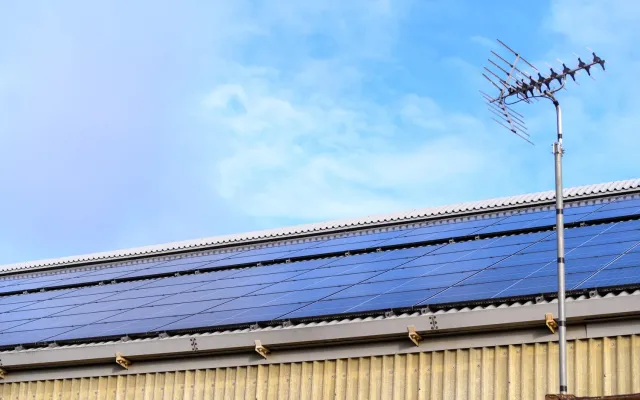
Our client runs some of the UK’s busiest rail operations, with depots and stations that have large roof areas and high daytime electricity demand, which works well with for rooftop solar PV. In practice, however, conventional commercial solar routes can be hard to progress.
Working with our community energy partner, we developed an alternative approach, of community-owned solar PV delivered through a Power Purchase Agreement (PPA). Electricity generated on-site is sold to the client at an agreed discounted rate, while surplus revenues support environmental and social programmes in the neighbourhoods closest to the railway. The result is a model that accelerates decarbonisation and turns rail rooftops into assets with a visible local legacy.
Across the programme, it delivered meaningful renewable generation with no upfront capital from our client, kept live rail operations running safely throughout installation, and ensured benefits extended beyond carbon savings. At one depot, an additional requirement was to integrate battery storage to improve self-consumption and reduce peak grid imports.
Carbon3 was appointed to design and deliver three schemes: Selhurst (1,013.4 kWp solar PV with a 200 kW battery), Streatham (231.2 kWp) and Three Bridges (909.9 kWp). Together, these installations demonstrate how community energy can be scaled across operational rail sites without slowing day-to-day service delivery.
Carbon3 provided a full turnkey service across the three locations, from surveys and design through to installation, commissioning and handover. Selhurst depot served as the flagship project, combining a large rooftop array with battery storage, while Streatham and Three Bridges added significant additional generation capacity across the network.
We carried out structural and condition surveys to confirm roof capacity and identify safe working and exclusion zones.
System layouts were engineered to protect operational requirements, including overhead line equipment, crane routes, maintenance platforms and access corridors, whilst maximising generation. We managed DNO applications and grid connection requirements. At Selhurst, a 200 kW battery was specified to optimise self-consumption and provide peak-shaving during periods of high demand.
Installation was planned around depot and station operations, with sequencing aligned to maintenance windows and access constraints. Our teams worked under robust rail safety controls for interfaces with live infrastructure and overhead systems. Where needed, weekend and out-of-hours activity reduced impact on daytime operations. The programme was delivered without interrupting rolling stock servicing or station functioning.
At Selhurst, the battery system captures surplus solar generation when demand is low and releases it during peak periods. This increases on-site renewable utilisation, cuts reliance on grid imports at higher tariff times, and supports more stable depot demand profiles.
Our community energy partner owns and operates the assets across Selhurst, Streatham and Three Bridges. Our client buys the electricity generated on-site at a discounted PPA rate, securing immediate savings and lower Scope 2 emissions without balance-sheet capital spend. Any surplus generation can be exported or sold on, and net proceeds (after project costs) are reinvested into local community activity, from greening projects and youth programmes to environmental education in areas neighbouring the rail estate.
At Selhurst alone, the 1,013.4 kWp PV system generates approximately 861,390 kWh each year, enough to make around 29 million cups of tea or supply roughly 320 average UK homes for 12 months. Combined with the additional schemes at Streatham (231.2 kWp) and Three Bridges (909.9 kWp), the programme delivers material renewable generation across our client’s operational footprint alongside long-term energy cost benefits.
Using UK grid carbon intensity assumptions, the three train stations offset 470 tonnes of CO2e per year. Across the 20-year PPA term, that totals more than 9,400 tonnes of avoided emissions – broadly comparable to removing about 6,400 petrol cars from the road for a year.
The community PPA structure meant our client did not need to fund the installations upfront. Our community energy partner financed the build, retains ownership of the equipment, and is responsible for ongoing operation and maintenance, while our client benefits from lower electricity costs from day one and inherits the system after 15 years.
Because the community energy organisation reinvests surplus income locally, communities around the rail corridor share in the value created. Funding supports practical, visible initiatives such as new and improved green spaces, climate education, youth engagement and other environmental projects, helping shift perceptions of railway infrastructure from a local impact to a local benefit.
At Selhurst, the 200 kW battery adds flexibility by smoothing demand, helping reduce peak demand charges, and providing an additional layer of operational resilience. It also increases the proportion of solar energy used on-site rather than exported.
This programme shows that decarbonisation can be designed to work for operators and neighbours at the same time. Our client reduces electricity costs and emissions, while the community energy organisation channels value back into local projects, creating a shared outcome from infrastructure that already exists.
With thousands of depots, stations and rail facilities offering suitable roof space, there is a significant opportunity to scale rooftop renewables across the sector. The community PPA approach proven here provides a practical route to delivery where capital constraints would otherwise slow progress.
Pairing solar with battery storage can further increase the value of onsite generation by improving self-consumption, enabling peak-shaving and creating optionality for future flexibility services. Over time, this helps rail depots move from being solely energy users to becoming active participants in a smarter energy system.
If you need to cut emissions quickly without upfront capital, this model is ready to replicate. Get in touch to discuss how it could work across your estate.